

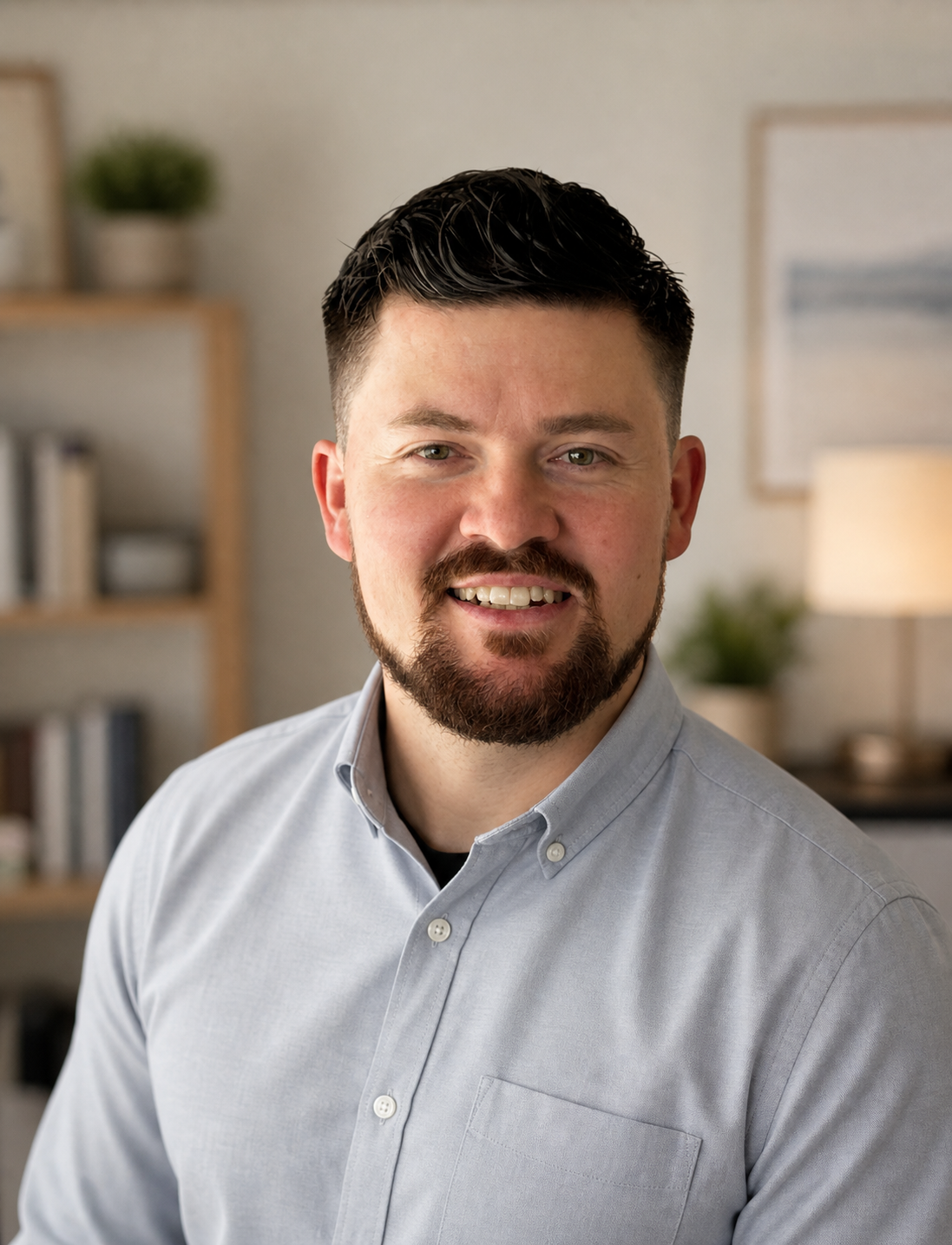
About Dr. Scholl—Licensed Clinical Psychologist in San Diego, CA
CA License: PSY: 36754
When you're carrying something heavy — the weight of trauma, of service, of a diagnosis you don't fully understand yet — you deserve a therapist who takes that weight seriously. My training in trauma-focused approaches like CPT, DBT, and ACT means I can offer more than a listening ear — I can offer a path forward."

A Therapist Who Understands What You've Been Through
My clinical background spans high-acuity settings, not just outpatient offices — inpatient psychiatric units, intensive outpatient programs, and specialized trauma programs. That experience shapes how I show up in session: steady, clear-headed, and unlikely to be rattled by complexity. Whether we're working through anxiety, trauma, a major life transition, or something you can't quite put a name to yet, you can expect that same grounded approach. You can read more about how I structure that work on my therapy services page.

A Background Built in High-Acuity Settings
Much of my clinical training has focused specifically on trauma and PTSD, in settings that treated people at their most acute. For two years, I ran weekly Cognitive Processing Therapy (CPT) groups at the intensive outpatient level, facilitated DBT and process groups on inpatient units, and carried an individual caseload treating trauma, mood disorders, dual-diagnosis, and personality disorders — often with patients in crisis. I also conducted suicide and safety risk assessments as part of that work. What it taught me, more than anything, is how to move carefully with people in their hardest moments — and how to build real trust quickly, without cutting corners to get there.
That foundation shapes how I approach trauma and PTSD treatment more broadly — whether it stems from a single event, the kind of weight that builds when hard things keep happening, or a source you haven't been able to fully pin down yet. It's also why I work well with first responders and others whose day-to-day exposure to crisis takes a toll most people don't see. You can read more about my trauma-focused approach on my trauma therapy page.
Rigorous, Evidence-Based Care
Evidenced-Based Care
I don't believe in guessing whether therapy is working — I believe in tracking it. I regularly use validated assessment tools like the BDI-II, PSQI, and PCL-5 to measure progress over the course of treatment, and I draw from CPT, DBT, CBT, ACT, and TriGR depending on what actually fits your situation, not a onesize-fits-all protocol.
A Foundation in Neuroscience
Early in my training, I worked at UC Irvine's Institute for Memory Impairments and Neurological Disorders, administering neuropsychological batteries as part of a longitudinal Alzheimer's study, and completed a neuropsych assessment practicum at Hoag Memorial Hospital's Pickup Family Neuroscience Institute. At Hoag, I worked as part of a multidisciplinary team alongside neurologists, participating in epilepsy surgical case conferencing and evaluating patients with a range of neurological disorders referred from the clinic's neurologists. That early experience is where my approach to care really took shape — it taught me to look at the whole person, not just an isolated symptom, and it's part of why I hold mind, body, and soul together as a single picture of health rather than treating them separately."

Education and Licensure
Licensed Clinical Psychologist, California (License # PSY36754)
1
APA-Accredited Predoctoral Internship — Aurora Behavioral Healthcare, San Diego
2
Postdoctoral training — Aurora Behavioral Healthcare, San Diego
3
Clinical/research training — UC Irvine Institute for Memory Impairments and Neurological Disorders
4
Neuropsychological assessment training — Pickup Family Neuroscience Institute, Hoag Memorial Hospital
5
Education— Rosemead School of Psychology, Biola University
6
Why I do This Work

I'm passionate about this work because I want to help people move from feeling weighed down to feeling free — free to engage with their lives without being held back by pain they didn't choose. Watching that shift happen is why I do what I do.
I also believe people are made of mind, body, and soul — and that these three aren't separable. You can't fully care for one in isolation from the others. That conviction shapes how I practice as a Christian therapist, whether or not faith ever comes up in our sessions. You can read more about what that looks like on my Faith Integration page.
Ready to Start?
If you have questions before booking, you can reach out here: (858) 683-6857 or you can head to my Contact Page to schedule your first session.